Sir Tom Finney remains Preston North End's greatest ever player, a one-club man who turned down riches abroad to stay loyal to his hometown team. Born just a few hundred yards from Deepdale stadium, he balanced a career as a professional footballer with his trade as a plumber, earning him the enduring nickname "The Preston Plumber."
A Preston Childhood and Plumbing Apprenticeship
Thomas Finney was born on 5 April 1922 at his parents' home on St Michael's Road in Preston, within sight of the Deepdale ground where he would later become a legend. His early childhood was marked by tragedy; his mother Maggie died in 1927 when Tom was just five years old, leaving his father Alf to raise Tom, his elder brother Joe, and four sisters.
The family later moved to Daisy Lane in the Holme Slack area of the city. Finney left school in 1936 at the age of 14, standing only 4 ft 9 in and described as somewhat frail. That same year, he began an apprenticeship with Pilkington's, a local plumbing firm. His father insisted that he complete this apprenticeship before pursuing football professionally, a decision that would shape Finney's life and public image.
The Rise of a Local Hero
Finney had already been playing football locally when he saw an advert in the Preston paper requesting players to attend a trial at Deepdale. His father helped arrange the opportunity, and Preston trainer Will Scott watched the young winger produce what was described as "an outstanding match." The club offered him a contract worth £2 10s per week, but Alf Finney refused permission until his son had completed his plumbing apprenticeship.
Finney joined Preston North End as an amateur in 1937, training in the evenings after work. He signed professional wartime terms in January 1940 at ten shillings a match, making his first-team debut on 31 August 1940 against Liverpool at Anfield at the age of 18. During the war years, Preston won the North Regional League and the Football League War Cup, defeating Arsenal 2–1 in a replay at Blackburn's Ewood Park.
Post-War Stardom and the Preston Plumber
Finney's Football League debut came on 31 August 1946 against Leeds United at Deepdale, where he scored in a 3–2 victory. Newspaper reports described his performance as "a one-man show," with his goal singled out as "a brilliant solo effort."
Post-war demand for plumbers ensured that Finney had a second income to supplement the £14 he received as a footballer. He became known as "The Preston Plumber" and ran his own successful plumbing business from the 1940s until the 1990s. This financial security allowed him to remain loyal to Preston North End when bigger clubs came calling.
In 1952, Italian club Palermo offered £10,000 for Finney's services. Preston chairman Nat Buck rejected the approach, and Finney remained a one-club player throughout his career. He made 433 League appearances for Preston, scoring 187 goals; a club record that stands to this day.
England Career and International Recognition
Finney made his England debut on 28 September 1946 against Ireland at Windsor Park in Belfast, scoring in a 7–2 victory. He later described it as his "proudest day as a footballer."
Over the next twelve years, he earned 76 caps and scored 30 goals for England. In June 1958, he became the joint all-time top scorer for his country, sharing the record with Vivian Woodward and Nat Lofthouse. He became the sole record holder in October 1958, a milestone he held until Bobby Charlton surpassed it in 1963.
Near Misses and Unfulfilled Glory
Despite his individual brilliance, major team trophies eluded Finney. Preston were Second Division champions in 1950–51 and reached the First Division, where they finished as runners-up in 1952–53 and again in 1957–58. The 1952–53 title race was particularly cruel; Preston finished level on points with Arsenal, but the London club won the title by the margin of 0.099 of a goal after a final-day victory over Burnley. It was the closest Finney came to a League championship.
In 1954, he played in his only FA Cup final, as Preston lost 3–2 to West Bromwich Albion. Persistent groin injuries forced his retirement in 1960; Preston were relegated the following season and have not returned to the top flight since.
A Gentleman of the Game
Finney was never booked or sent off during his entire career. Both on and off the pitch, he maintained a reputation as a total gentleman. He won the Football Writers' Association Footballer of the Year award twice, in 1953–54 and 1956–57; the first player to achieve this feat.
His peers held him in the highest regard. Bill Shankly called him "the greatest player I ever saw, bar none," adding that Finney "could have played all day in his overcoat." Stanley Matthews ranked him alongside Pelé, Diego Maradona, George Best and Alfredo Di Stéfano as one of the few players who could "dictate the pace and course of a game on a regular basis." Former Scotland and Manchester United manager Tommy Docherty went further, declaring in 2012 that "Messi is Finney reborn."
Legacy in Preston
Finney's connection to his hometown endured long after his retirement. He married Elsie Noblett in 1945, and the couple remained together until her death in 2004. Their two children, Brian and Barbara, were born in 1947 and 1950 respectively. After Elsie developed Alzheimer's disease, Finney became a strong supporter of the Alzheimer's Society.
Two Preston care homes bear the Finney name: Finney House and Lady Elsie Finney House. In April 2014, Bamber Bridge FC renamed their Irongate Ground the Sir Tom Finney Stadium. Kendal Town, the non-league club that had rejected Finney for a trial in 1939, later made him their president; 70 years after that rejection, the club chairman apologised and called it "the biggest mistake in football history."
The Splash and Permanent Remembrance
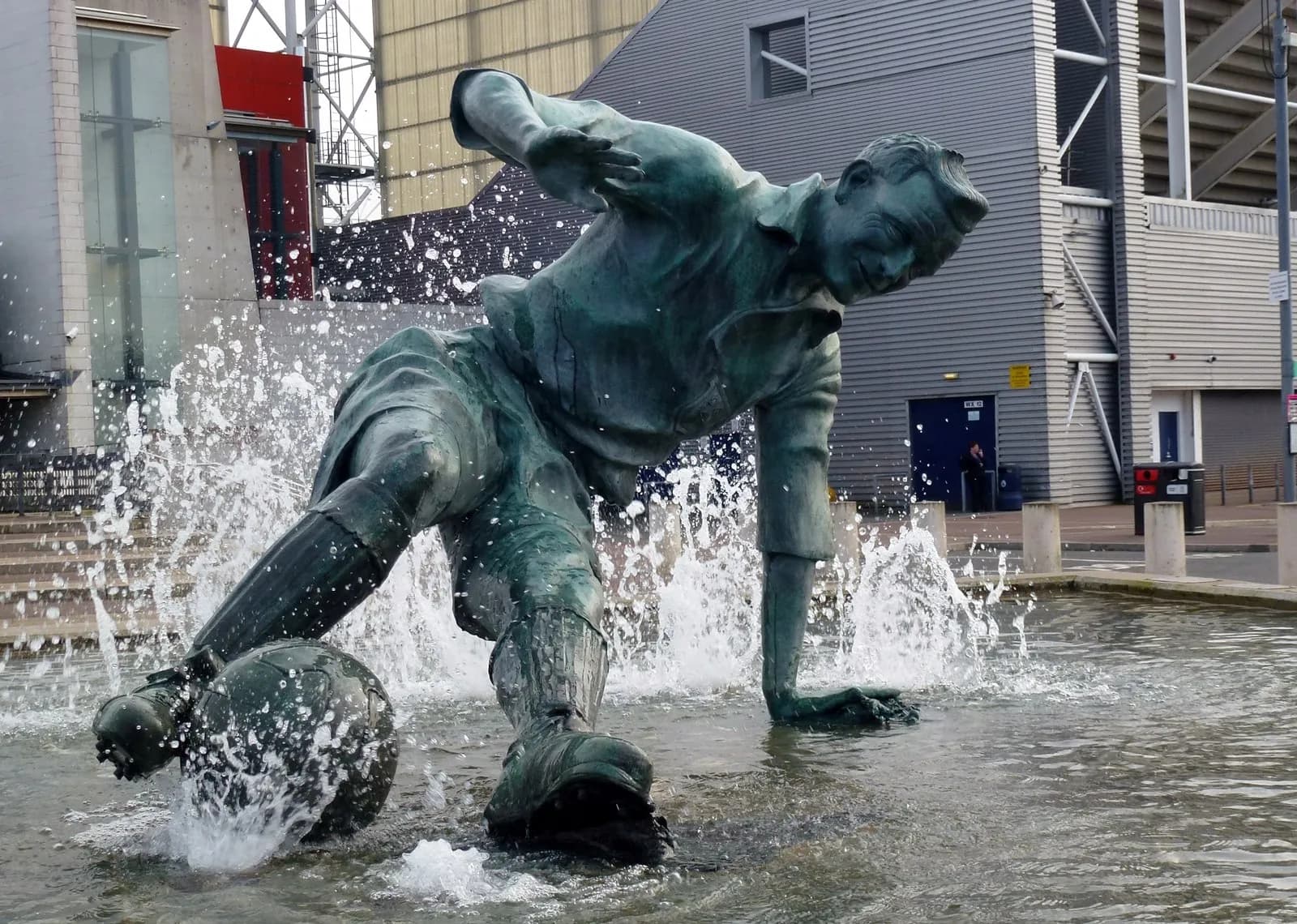
Finney's most visible legacy stands outside Deepdale. "The Splash," a bronze statue by sculptor Peter Hodgkinson, was unveiled on 31 July 2004. It depicts Finney beating two Chelsea defenders on a waterlogged Stamford Bridge pitch in 1956, based on a photograph that won the Sports Photograph of the Year award. The Sir Tom Finney Stand at Deepdale also bears his name, ensuring that every matchday at Preston North End reminds supporters of their greatest ever player.
Sir Tom Finney died in Preston on 14 February 2014, aged 91. On what would have been his 100th birthday in April 2022, Preston marked the occasion with a West Lancashire derby against Blackpool at Deepdale. A crowd of 18,740 watched Preston win 1–0; a fitting tribute to a man who dedicated his life to his hometown club, both on the pitch and with a wrench in hand.